Humanoid robots
Humanoid robots in manufacturing: which tasks fit first
Humanoid robots have moved from demos to trial runs on real production lines, and BMW with Figure AI is the best documented example so far. This page covers which manufacturing tasks they suit, when a fixed robot or cobot is the better choice, and what your shop floor and systems need before a pilot.
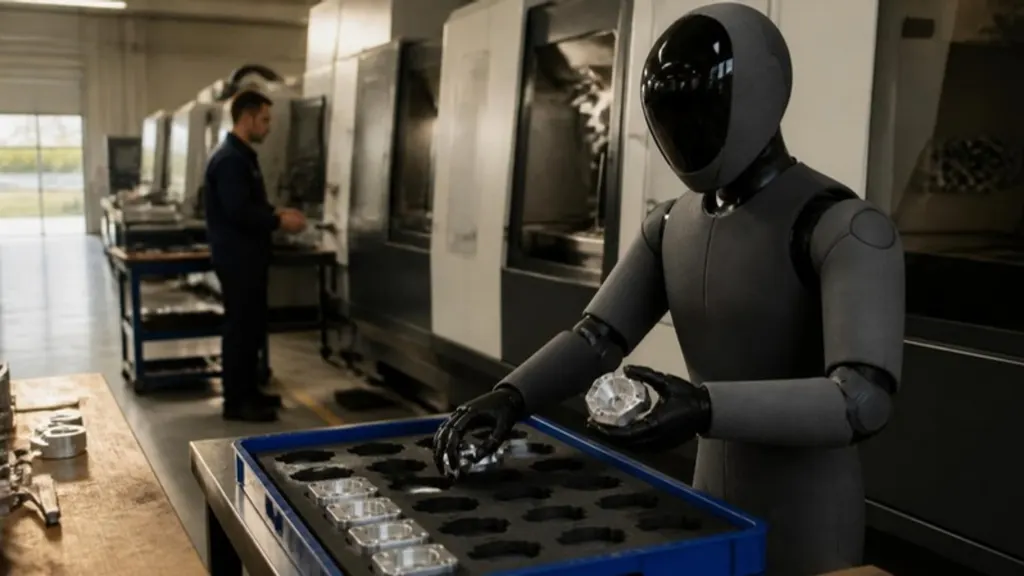 Illustrative image
Short answer
A humanoid robot suits manufacturing tasks that vary and take place in a workplace built for people, such as material handling, kitting, placing parts in fixtures, machine tending and simple subassembly. For one fast, repetitive movement an industrial robot or cobot is usually the better choice. Start with one task, check safety and the link with your ERP or MES, and run a small pilot with criteria agreed in advance.
Which manufacturing tasks suit a humanoid robot?
Tasks that a person now does by hand, in a workplace laid out for people, and that change from day to day. In manufacturing that usually means material handling, kitting, placing parts in fixtures, machine tending and simple subassembly. The more a task varies, the more a general purpose robot can add compared with a dedicated cell.
Small and thin parts ask a lot of the hands. According to Figure, Figure 03 has a camera in each palm and tactile sensors in the fingertips that detect forces as small as three grams.
Figure says its own robot factory, BotQ, uses Figure humanoids running Helix to assemble components and handle material on its lines. That is the maker's own plant, and the claim comes from Figure alone.
| Task | What the robot does | Check first |
|---|---|---|
| Material handling | Takes parts from a delivery container or rack and brings them to the line, sometimes pulling a cart | Routes, floor space and how much the parts differ in size and weight |
| Kitting | Collects the parts for one order or workstation in a tray or box | Whether your ERP or MES can tell the robot what goes in each kit |
| Placing parts in fixtures | Puts a part in a jig or fixture for the next welding or assembly step, as at BMW | Cycle time and how accurate the placement has to be |
| Machine tending | Loads a blank into a machine and takes out the finished part | How often the product changes; for a single product a fixed robot is often simpler |
| Simple subassembly | Joins a few parts with hand movements such as inserting or clicking | Tolerances, and how a failed step is noticed |
Sources
- Figure: introducing Figure 03 (figure.ai)
- Figure: BotQ, high-volume manufacturing for humanoid robots (figure.ai)
What did Figure's humanoid robots do at BMW?
In 2024 BMW tested Figure 02 at Plant Spartanburg, placing sheet-metal parts in fixtures for the chassis. In the deployment that followed, which ran for almost a year, BMW reports that Figure 02 supported the production of more than 30,000 BMW X3 and moved over 90,000 components, in ten-hour shifts, five days a week.
According to Figure, the task came with a cycle requirement of 84 seconds, of which 37 seconds to load, and a placement target of over 99% success per shift. Any manufacturing pilot needs numbers like these agreed before it starts.
BMW also names what had to change on the floor. The pilot led to revised safety concepts with additional barriers and partitions, and to better 5G coverage in the hall.
In June 2026 both companies reported on Figure 03 at the same plant. BMW describes a sequencing task in which delivered components arrive unsorted in larger containers and Figure 03 picks them up and sorts them. Figure adds that the robot switches between placing thin-walled parts in the correct slot and pulling a large metal cart down the line. In Germany, BMW started a pilot with another humanoid robot, AEON from Hexagon, at Plant Leipzig (February 2026).
All figures in this section come from BMW and Figure themselves.
Sources
- BMW Group: successful test of humanoid robots at Plant Spartanburg (2024) (press.bmwgroup.com)
- BMW Group: humanoid robots in production in Germany for the first time (press.bmwgroup.com)
- BMW Group: Figure 03 project in Spartanburg (press.bmwgroup.com)
- Figure: F.02 contributed to the production of 30,000 cars at BMW (figure.ai)
- Figure: F.03 arrives at BMW (figure.ai)
When is an industrial robot or cobot the better choice?
When a task is one movement repeated all day, a fixed industrial robot is usually faster and more accurate. A cobot fits when people and robot share a workstation and series are small. The International Federation of Robotics writes that humanoids will not compete with traditional industrial robots on speed, precision, reliability and repeatability.
A line can combine these. An AMR brings the containers, a cobot does the fine assembly and people handle the exceptions. As of October 2026 a humanoid robot is one more option in that mix, and the least proven one in daily production.
| Type | Fits well when | Less suitable when |
|---|---|---|
| Industrial robot in a fixed cell | High volume, the same movement, few product changes | Tasks change often or the space has to stay open for people |
| Cobot | People and robot work at the same workstation; small series that are quick to reprogram | Heavy parts or high speeds |
| AMR or AGV | Goods move between fixed points across the floor | Parts have to be picked, placed or assembled |
| Humanoid robot | Varied tasks in a workplace built for people, without rebuilding the line | One fixed movement at full speed; no published safety standard for humanoids yet |
Sources
What does your shop floor need for a humanoid robot?
Room to work, a safety approach based on a risk assessment, reliable wireless coverage and fixed places for parts, carts and charging. As of October 2026 there is no published ISO safety standard specifically for humanoid robots. ISO is developing one for dynamically stable industrial mobile robots, which includes legged robots.
Involve operators early. They know where parts really end up and which steps go wrong, and they are the ones who will work next to the robot.
- Safety standards. ISO 10218-1 and ISO 10218-2, both from 2025, cover industrial robots and robot cells, including collaborative applications. ISO/CD 25785-1 for legged and other dynamically stable robots is at Committee Draft stage.
- Separation. At BMW the pilot led to extra barriers and partitions, and you can expect the same discussion on your own floor.
- Network. BMW improved 5G coverage in the hall. Check coverage where the robot will work, including behind racks and in corners.
- Fixed places. Containers and kits need a consistent location and orientation, also when a colleague puts them down.
- Charging. Figure 03 charges wirelessly by stepping onto a charging stand, according to Figure, so that stand needs a spot along its route.
Sources
How does a robot connect to your ERP and MES?
The robot's own software controls its movements. It still needs to know which order, kit or part comes next, and your systems need to hear back what was done. That information lives in your ERP or MES. Decide early which data the robot receives, what it reports back and who acts on an error.
Take kitting. The ERP knows the order and the bill of materials, and the MES knows which workstation needs the kit and when. If a part is missing, planning wants to know before the line stops. A quality deviation belongs in your quality or service system.
Figure runs its own lines at BotQ on custom manufacturing execution software across more than 150 networked workstations. Even the robot maker treats the link with production software as part of the work.
AI agents can take the information side of this. An agent connected to your ERP and MES could prepare the pick list for a kit, report a shortage to planning and log an exception, while the robot does the physical step. Building agents like that, connected to ERP, CRM and service systems, is our daily work.
Sources
- Figure: ramping Figure 03 production (figure.ai)
How do you set up a pilot with robots in manufacturing?
Start with one task and measure how it runs today. Check the workplace and safety, map the data flow with your ERP or MES and compare robot types against the same task. Then run a small pilot with criteria agreed in advance and manual work as a fallback, and decide on scale only after that.
As of October 2026, Figure publishes no price and no order page for Figure 03 on figure.ai. Figure says robots from its factory go, among other things, to commercial use-case development, so availability is something to discuss with the maker.
01
Choose one task
Frequent, physically tiring or hard to staff, and with enough variation that a fixed cell has never paid off.
02
Measure the current situation
Cycle time, number of variants, how often the task changes and where errors occur. A pilot without that baseline proves little.
03
Check workplace and safety
Routes, separation, wireless coverage and a risk assessment, together with your safety officer and the operators involved.
04
Map the data
What the robot needs from ERP or MES, what it reports back and who handles exceptions.
05
Compare options
Fixed robot, cobot, AMR and humanoid robot, each against the same task description.
06
Run a short pilot
Agree criteria up front, such as cycle time and placement success per shift, as BMW and Figure did. Keep manual work as a fallback.
07
Decide on scale
Review the results with the operators, then extend, adjust or stop.
Sources
- Figure: Figure 03 product page (figure.ai)
- Figure: ramping Figure 03 production (figure.ai)
How does BeeManaged help with robotics in manufacturing?
We help manufacturing companies with the orientation. Together we look at which tasks qualify, what they ask of the workplace, safety, systems and people, and how a robot fits into the same process as your AI agents.
We build AI agents that work along in the processes of manufacturing and engineering companies, connected to ERP, CRM and service systems. That is the angle we bring to robotics, with the robot as one step in a process that also runs on data. An orientation starts with a conversation about one or two tasks you have in mind.
Updated · As of October 2026 · Author Roy Rutten, AI architecture and development
Frequently asked questions
Are humanoid robots already used in manufacturing?
Yes, in trials and early deployments. BMW used Figure 02 for almost a year at Plant Spartanburg to place sheet-metal parts for welding, and in 2026 Figure 03 started on logistics tasks at the same plant. Wide use in everyday production has not arrived yet.
Which manufacturing tasks suit a humanoid robot first?
Tasks with variation in a workplace built for people, such as material handling, kitting, placing parts in fixtures, machine tending and simple subassembly. A fixed, fast and repetitive task is usually better served by an industrial robot or a cobot.
What does a humanoid robot cost?
As of October 2026, Figure publishes no price and no order page for Figure 03 on figure.ai. Prices that circulate in the media are not confirmed by the maker, so ask the maker directly.
Is there a safety standard for humanoid robots?
There is no published ISO standard specifically for humanoid robots as of October 2026. ISO is working on ISO/CD 25785-1 for dynamically stable industrial mobile robots, including legged robots. Until then you work with the existing robot standards, such as ISO 10218, and a risk assessment of your own workplace.
Does a humanoid robot need a link with our ERP or MES?
For anything beyond a demonstration, it does. The robot needs to know which order, kit or part comes next, and your systems need to know what was done and what went wrong.
How does BeeManaged help with robots in production?
We help with the orientation and build AI agents that connect to your ERP, CRM and service systems, so a robot can become part of the same process.
Related
Robotics
Humanoid robots for manufacturing and logistics
Humanoid robots
Humanoid robot or cobot: which fits your shop floor?
Humanoid robots
Figure 03: what the Figure AI humanoid robot does at work
Humanoid robots
Humanoid robots in logistics: where they fit in your warehouse
Use cases
Internal AI agent: ask your own systems in plain language
Plan an orientation call about robotics in your production
Tell us which task you have in mind and how your production is set up. We look together at whether a humanoid robot, a cobot or a fixed cell fits, and what it asks of your workplace and systems.