Humanoid robots
Humanoid robots in logistics: where they fit in your warehouse
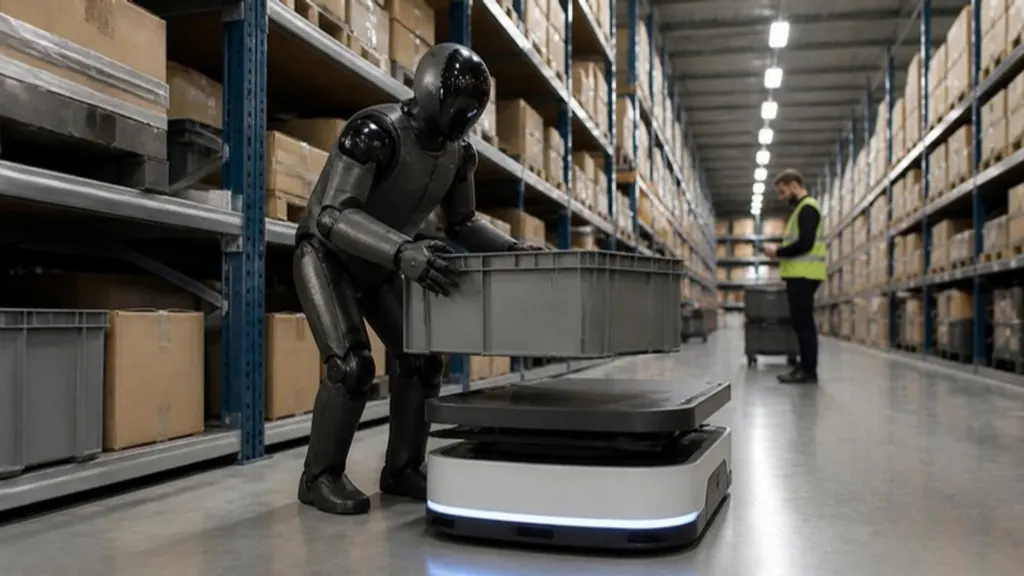
Warehouses already run on conveyors, AMRs and fixed pick-and-place cells, and for steady flows those do the job well. A humanoid robot becomes interesting for the work in between, where goods, containers and routes change too often for a fixed installation.
 Illustrative image
Short answer
A humanoid robot in logistics takes on varying tasks in a space laid out for people, such as sorting mixed packages, picking parts from containers and moving carts. Figure has shown package handling and, at BMW, sorting of parts. For steady, high-volume flows an AMR, AGV or fixed cell is usually faster. BeeManaged helps you work out which tasks qualify and how a robot connects to your WMS and ERP.
Which logistics tasks suit a humanoid robot?
A humanoid robot suits tasks where the goods or the order vary and the workplace is laid out for people. Think of sorting mixed packages, sequencing loose parts, filling totes for the line and moving carts. Repetitive flows of identical boxes usually belong on a conveyor or in a fixed cell.
Loading and unloading trucks and depalletising mixed pallets are obvious candidates as well. For those tasks, ask a vendor to show the robot on your own goods first, because the published examples so far are about packages and parts.
- Taking parcels, bags and envelopes off a belt, turning them so the label faces the scanner and putting them on the next belt.
- Picking unsorted parts from a larger container and putting each one in the right slot of a rack or tote, also called sequencing.
- Kitting for the production line, where the parts for one order or one product go into a single tote.
- Pulling or pushing carts between the buffer and the line.
What has Figure shown in logistics so far?
Figure has published two kinds of logistics work. Its robots move packages from one conveyor to another and turn each one so the label faces the scanner. At BMW Group Plant Spartanburg, Figure 03 picks parts from unsorted containers and sorts them. The figures come from Figure and BMW themselves.
On packages, Figure reported in June 2025 that its Helix model handled one package every 4.05 seconds, against about 5.0 seconds three months earlier. According to Figure, labels faced the scanner correctly about 95% of the time (up from about 70%), and poly bags and flat envelopes went as reliably as rigid boxes. Figure also measured the effect of training data. Going from 10 to 60 hours of demonstrations cut the average time per package from about 6.84 to 4.31 seconds.
At BMW, Figure 03 arrived in Hall 52, an assembly and logistics hall, in June 2026. BMW calls it a sequencing use case. Delivered components arrive unsorted in larger containers, and Figure 03 picks them up and sorts them. Figure adds that the robot switches between placing thin-walled parts in the correct slot and pulling a large metal cart on caster wheels down the line, controlled by its Helix 02 model.
Before that, Figure 02 worked on sheet-metal parts at the same plant for almost a year. The Figure 03 page covers that deployment.
Sources
- Figure: Scaling Helix, humanoid logistics (figure.ai)
- Figure: Helix accelerating real-world logistics (figure.ai)
- Figure: F.03 arrives at BMW (figure.ai)
- BMW Group: Figure 03 project in Spartanburg (press.bmwgroup.com)
Humanoid robot, AMR, AGV or pick-and-place cell: which one when?
AGVs and AMRs move loads, a fixed pick-and-place or palletising cell repeats one handling task at speed, a cobot works next to people at one station, and a humanoid robot combines walking and handling in a space built for people. Most warehouses end up with a mix.
In its 2025 position paper on humanoid robots, the International Federation of Robotics writes that humanoids "will not compete with traditional industrial robots in terms of speed, precision, reliability and repeatability". So for a steady flow, a conveyor or fixed cell stays the first choice. A humanoid robot earns a closer look where that flow breaks into exceptions and walking between stations.
| Type | What it does | Works best when | Watch out for |
|---|---|---|---|
| AGV (automated guided vehicle) | Moves pallets, carts or totes along fixed routes, guided by markers, magnetic tape or reflectors | Routes and volumes are stable | A new route means changing the layout or the programming |
| AMR (autonomous mobile robot) | Moves loads and plans its own route with sensors and a map of the building | Routes change and people share the aisles | It moves goods; picking needs an arm on top or a person |
| Fixed pick-and-place or palletising cell | Picks, places or stacks at one station, often behind guarding | High volumes of similar products | Little room for new products or a different layout |
| Cobot | Robot arm that works in a shared space with people, under the ISO 10218 safety requirements | One workstation with small series and some variation | It stays at its station and does not walk to the next task |
| Humanoid robot | Walks, picks with two hands and moves carts in a space laid out for people | Tasks vary and moving and handling goods go together | Speed, availability and safety standards are still developing |
Sources
- IFR: Humanoid robots, vision and reality (ifr.org)
What does a humanoid robot ask of your warehouse?
It usually takes less rebuilding than a fixed installation, though more than plugging it in. The robot needs network coverage, charging points, fixed places for containers and clear agreements on where people and robot work side by side. BMW names extra barriers and partitions and better 5G coverage in the hall as lessons from its pilot.
Safety needs extra attention. As of October 2026 there is no final ISO safety standard specifically for humanoid robots. ISO is drafting ISO/CD 25785-1 for dynamically stable industrial mobile robots, such as robots on two legs that could become unstable without power, and it is still at committee draft stage. Until it is published, the requirements for robot applications in ISO 10218-2:2025 and a risk assessment of your own floor are what you work from.
Charging affects how many hours a robot is available. According to Figure, Figure 03 has charging coils in its feet and charges at 2 kW by stepping onto a wireless stand, so it can recharge during the day. Decide early where those stands go.
- Wifi or 5G coverage along the whole route, including the corners where the robot turns or waits.
- Fixed, labelled locations for containers, totes and carts.
- Safety zones and a risk assessment, worked out with the people who do the job today.
- An owner for the robot: who restarts it, who clears a stuck package and who logs incidents.
Sources
How does a warehouse robot connect to your WMS and ERP?
A robot adds value once it knows which order, which tote and which slot. That information sits in your WMS or ERP. The link sends tasks to the robot or its fleet software and reports back what was done, so stock and order status stay correct. Anything the robot cannot finish goes to a person.
The questions match any system link: which data the robot needs, which system leads and what happens when a task fails. Ask the vendor early which interface its software offers, because that decides how much custom work the link takes.
BeeManaged builds AI agents that work in the processes of manufacturing and engineering companies and connects them to ERP, CRM and service systems. With a robot on the floor, an agent could take the exceptions, such as a damaged package or a missing part, and pass them to the right colleague with the order data. We look at the robot and the agents as one process running on the same systems.
How do you start with robots in your warehouse?
Choose one task and describe how it runs today, including volumes, variants and exceptions. Compare the robot types against that task, check the floor and the data flows, and only then ask vendors for a demonstration on your own goods. A pilot with go and no-go criteria agreed in advance comes last.
In an orientation conversation we go through these steps with you: which tasks qualify, which questions to put to vendors and what your systems would need. The outcome may just as well be an AMR or a cobot.
01
Pick one task
Choose a task with a clear start and finish, such as sorting returns or filling totes for one line, and write down its volumes and exceptions.
02
Compare the options
Check whether an AMR, a conveyor, a fixed cell or a cobot would solve it. A humanoid robot makes sense when those fall short on variation or space.
03
Walk the floor
Go through the route with the team that does the work and note network coverage, charging spots and where people and robot meet.
04
Map the data
List which data the robot needs from your WMS or ERP, what it reports back and who handles the exceptions.
05
Test on your own goods
Ask vendors for a demonstration with your packages, totes or parts. Agree pilot criteria beforehand, such as cycle time, error rate and how often someone has to step in.
Can you buy a Figure 03 for your warehouse?
Figure 03 has no public price or order page. As of October 2026, Figure publishes neither on figure.ai. Figure says robots from its BotQ factory go to internal research, data collection, housework development and commercial use-case development. Ask the vendor directly about availability, terms and support in Europe.
Production is growing. In April 2026 Figure reported that it had delivered over 350 Figure 03 robots and raised output from one robot per day to one per hour.
Sources
- Figure: ramping Figure 03 production (figure.ai)
Updated · As of October 2026 · Author Roy Rutten, AI architecture and development
Frequently asked questions
What is the difference between an AGV and an AMR?
An AGV follows fixed routes using markers, magnetic tape or reflectors, so a new route means changing the layout or the programming. An AMR maps the building with its sensors and plans its own route around people and obstacles. Both move goods, and neither picks them unless an arm is mounted on top.
Is a humanoid robot faster than a fixed pick-and-place robot?
Usually it is slower than a fixed cell. The IFR wrote in 2025 that humanoids will not compete with traditional industrial robots on speed, precision, reliability and repeatability. A humanoid robot is interesting for tasks that vary too much for a fixed cell, while high-volume repetitive picking stays with the cell.
Which warehouse tasks has a humanoid robot done so far?
According to Figure, its robots have moved packages between conveyors and turned them so the label faces the scanner. BMW and Figure also describe a sequencing use case at BMW Group Plant Spartanburg, announced in June 2026, in which Figure 03 picks parts from unsorted containers and sorts them.
What does a Figure 03 cost?
Figure publishes no price for Figure 03 and no order page for businesses on figure.ai, as of October 2026. Amounts mentioned in the media are not published by Figure itself, so check any quote directly with the vendor.
Is there a safety standard for humanoid robots?
There is no final ISO safety standard for humanoid robots yet, as of October 2026. ISO/CD 25785-1 for dynamically stable industrial mobile robots, which includes robots on two legs, is at committee draft stage. Until then, ISO 10218-2:2025 for robot applications and your own risk assessment set the rules.
How does BeeManaged help with robots in logistics?
We build AI agents and connect them to ERP, CRM and service systems. For robotics we help with the orientation: which tasks qualify, what that asks of your workplace, safety, systems and people, and how a robot fits into the same process as your agents.
Related
Robotics
Humanoid robots for manufacturing and logistics
Humanoid robots
Humanoid robots in manufacturing: which tasks fit first
Humanoid robots
Humanoid robot or cobot: which fits your shop floor?
Humanoid robots
Figure 03: what the Figure AI humanoid robot does at work
Integrations
Integrations: connect your systems to an AI agent
Plan an orientation conversation about your warehouse
Tell us which warehouse or intralogistics tasks take the most hands and cause the most exceptions. We look together at whether a robot makes sense there, which type, and what your WMS, ERP and workplace would need.