Humanoid robots
Figure 03: what the Figure AI humanoid robot does at work
Figure AI builds general purpose humanoid robots, and Figure 03 is its third generation. This guide sets out what Figure and BMW have published about the robot, from Helix and the BMW plant in Spartanburg to production at BotQ, and what that means if you run a manufacturing or logistics company.
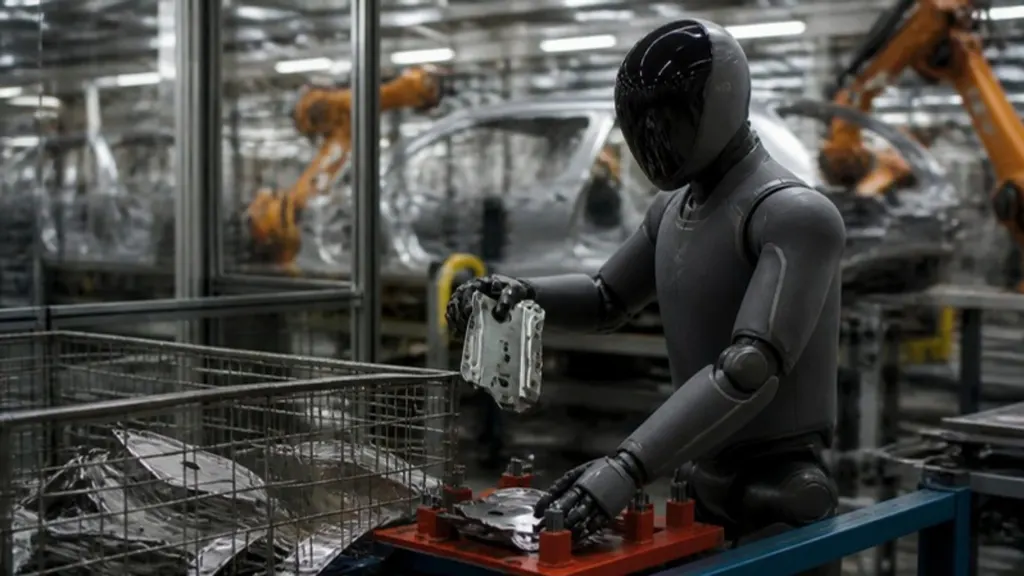 Illustrative image
Short answer
Figure 03 is the third-generation humanoid robot from Figure AI, announced in October 2025. It runs on Helix, Figure's own vision-language-action model, and is built in Figure's BotQ factory. At BMW Group Plant Spartanburg, Figure 03 is demonstrating a logistics task in which it sorts parts that arrive unsorted. As of October 2026 Figure publishes no price and no order page.
What is Figure AI?
Figure AI is the company behind the Figure humanoid robots. It designs the robot, the Helix AI model that controls it and BotQ, the factory that builds it. In September 2025 Figure announced a Series C round of more than $1 billion in committed capital, at a $39 billion post-money valuation.
Figure calls its robots general purpose: one machine for a wide range of human-like tasks, which it learns directly from people. Parkway Venture Capital led the Series C, with NVIDIA and Intel Capital among the other investors. For Figure 03 the company designed the actuators, batteries, sensors and electronics in-house.
Sources
- Figure: Series C announcement (figure.ai)
- Figure: introducing Figure 03 (figure.ai)
What is Figure 03 and how does it differ from Figure 02?
Figure 03 is the third generation of Figure's humanoid robot, announced in October 2025. Figure says it was designed for Helix, for the home and for production at scale. Compared with Figure 02 it is lighter and covered in soft textiles, it charges wirelessly, and it has new cameras, hands and tactile fingertips.
Figure says the hands and sensors matter most for commercial use, and that a robot which copes with the variety of a home can take on a wide range of tasks at work. We found no height, weight or payload for Figure 03 on figure.ai, so this page leaves them out.
In September 2026 Figure announced it is retiring the Figure 02 fleet, since maintaining it no longer made sense as the Figure 03 fleet grows. Most of them were melted down at a foundry in Imatra, Finland, to protect the hardware design.
| Part | Figure 03, according to Figure |
|---|---|
| Body | Soft textiles instead of hard machined parts, multi-density foam at pinch points, 9% less mass and significantly less volume than Figure 02 |
| Charging | Coils in the feet; the robot steps onto a stand and charges wirelessly at 2 kW |
| Cameras | Per camera twice the frame rate, a quarter of the latency and a 60% wider field of view than the previous generation |
| Hands | Softer fingertips, a camera in each palm and fingertip sensors that detect forces as small as three grams |
| Actuators | Twice as fast with higher torque density, which Figure links to faster pick and place |
Sources
- Figure: introducing Figure 03 (figure.ai)
- Figure: Figure 03 product page (figure.ai)
- Figure: retiring the Figure 02 fleet (figure.ai)
What is Helix, the AI that controls Figure 03?
Helix is Figure's vision-language-action model, or VLA: one neural network that links what the robot sees, the instruction it gets and the movements it makes. It runs entirely on the robot, on embedded low-power GPUs. Helix 02, published in January 2026, controls the whole body directly from camera pixels.
The first Helix, from February 2025, works in two layers. A vision-language model runs at 7 to 9 Hz and works out the scene and the instruction; a fast visuomotor policy turns that into continuous movement at 200 Hz. Figure uses one set of network weights for every behaviour, without separate fine-tuning per task.
Helix 02 adds a learned whole-body controller that Figure calls System 0, trained on more than 1,000 hours of human motion data plus reinforcement learning in simulation. According to Figure it replaces 109,504 lines of hand-written C++. Figure's demonstration is a four-minute autonomous task in which the robot walks through a kitchen, unloads a dishwasher and loads it again, without a reset or human help.
Sources
- Figure: Helix, a vision-language-action model (figure.ai)
- Figure: Helix 02 (figure.ai)
What did Figure robots do at BMW?
At BMW Group Plant Spartanburg, Figure 02 spent almost a year in 2025 placing sheet-metal parts that were then welded. BMW reports that the robots supported the production of more than 30,000 BMW X3 cars. Since June 2026 Figure 03 has been demonstrating a logistics task there, sorting parts that arrive unsorted.
It started in August 2024 with a trial of several weeks, in which Figure 02 inserted sheet-metal parts into fixtures for the chassis. For the longer deployment that followed, BMW reports ten-hour shifts five days a week, more than 90,000 components moved, some 1,250 operating hours and around 1.2 million steps. Figure adds that the task had an 84-second cycle with 37 seconds to load, and a target of more than 99% correct placements per shift.
BMW learned that the safety concept needed additional barriers and partitions, and that 5G coverage in the hall had to improve. Figure says the data from Spartanburg informed the design of Figure 03.
Figure 03 arrived in Hall 52, an assembly and logistics hall, in June 2026. BMW describes a sequencing task in which delivered components come in unsorted in larger containers and Figure 03 picks them up and sorts them. Figure shows the robot placing thin-walled parts in the correct slot and pulling a large metal cart down the line, on Helix 02. Both companies call this a demonstration. BMW has also set up a Center of Competence for Physical AI in Production.
Sources
- BMW Group: successful test of humanoid robots at Spartanburg (2024) (press.bmwgroup.com)
- Figure: F.02 contributed to the production of 30,000 cars at BMW (figure.ai)
- BMW Group: humanoid robots in production in Germany (press.bmwgroup.com)
- BMW Group: Figure 03 project in Spartanburg (press.bmwgroup.com)
- Figure: F.03 arrives at BMW (figure.ai)
What can Figure robots do in logistics?
Figure's best-documented logistics task is package handling. The robot takes parcels off one conveyor, turns each one so the shipping label faces the scanner and places it on the next belt. Figure published this in 2025 with the first Helix model, before Figure 03 was announced. At BMW, Figure 03 now demonstrates sequencing of parts.
The packages range from rigid boxes to poly bags and flat envelopes. Three months after the first deployment, Figure reports 4.05 seconds per package, about 20% faster, with the label correctly oriented about 95% of the time.
Figure trained this with demonstrations: going from 10 to 60 hours of demonstration data raised barcode success from 88.2% to 94.4%. How well a robot performs depends on the data collected for it, which is worth planning for in any pilot.
Sources
- Figure: Helix accelerating real-world logistics (figure.ai)
- Figure: scaling Helix in humanoid logistics (figure.ai)
How many Figure 03 robots does Figure build?
Figure builds its robots at BotQ, its own factory for humanoid robots. In April 2026 Figure reported more than 350 Figure 03 robots delivered, with output raised from one robot a day to one an hour. According to Figure, the first BotQ line can make up to 12,000 humanoids a year.
Parts that took over a week on a CNC machine now come out of tooled processes such as injection moulding in under 20 seconds, and Figure humanoids running Helix handle material on the BotQ lines themselves. When it announced Figure 03, Figure set a goal of 100,000 robots over four years. Robots from BotQ go to internal research, data collection, housework development and commercial use-case development.
Sources
- Figure: BotQ, a high-volume manufacturing facility (figure.ai)
- Figure: ramping Figure 03 production (figure.ai)
What does Figure 03 cost and can you buy one?
As of October 2026 Figure publishes no price for Figure 03, and figure.ai has no order page for businesses. Prices circulating in the media do not come from Figure. Figure says part of the BotQ output goes to developing commercial use cases.
We follow what Figure and BMW publish and update this page when that changes.
Sources
- Figure: ramping Figure 03 production (figure.ai)
- Figure: Figure 03 product page (figure.ai)
Is there a safety standard for humanoid robots?
As of October 2026 no ISO safety standard written specifically for humanoid robots has been published. ISO 25785-1, for industrial mobile robots that need active control to stay stable, such as robots on two legs, is at committee draft stage. Until it is published, safety is arranged per deployment; at BMW that meant additional barriers and partitions.
For industrial robots and robot cells, ISO 10218 applies. Its 2025 edition now includes the rules for collaborative applications that used to sit in ISO/TS 15066. The International Federation of Robotics (IFR) reports that ISO's robotics committee, TC 299, has started work on a global safety standard for humanoids and other legged robots.
Sources
What does Figure 03 mean for a manufacturing or logistics company?
The tasks Figure and BMW have shown are material handling: placing parts, sorting and sequencing, moving packages and carts. Most factories and warehouses have that work. The IFR states that humanoids will not compete with traditional industrial robots on speed, precision, reliability and repeatability, so a humanoid fits best where tasks vary and the workplace is built for people.
01
List the candidate tasks
Handling work that repeats but varies, such as parts to the line, kitting or sorting, with volumes and weights.
02
Compare with a cobot, fixed robot or AMR
For one stable task a cobot or fixed cell is often the simpler choice.
03
Check the workplace and safety
Walkways, floors, charging points, network coverage and separation from people.
04
Map the systems
A robot needs orders and stock data from your ERP, MES or WMS and reports back what it did, just like an AI agent in your office.
05
Plan a measured pilot
One task in one shift, with criteria agreed up front.
- Humanoid robots for manufacturing and logistics
- Which production tasks suit a humanoid robot
- Humanoid robots in warehousing and intralogistics
Sources
How does BeeManaged help with an orientation on humanoid robots?
BeeManaged builds AI agents that work in the processes of manufacturing and engineering companies and connects them to ERP, CRM and service systems. For robotics we help you get oriented: which tasks qualify, what they ask of the workplace, safety, systems and people, and how a robot fits into the same process as your agents.
Our part is the information around the robot: orders, stock, work instructions and reports in the systems you already use. In an orientation call we look together at your processes and the data a robot would need, and at the questions to put to a robot supplier.
Updated · As of October 2026 · Author Roy Rutten, AI architecture and development
Frequently asked questions
What is Figure AI?
Figure AI is the company that develops the Figure humanoid robots, the Helix AI model that controls them and the BotQ factory where they are built. In September 2025 it announced a Series C round of more than $1 billion at a $39 billion post-money valuation.
What is the difference between Figure 02 and Figure 03?
Figure 03 is the successor to Figure 02. According to Figure it has 9% less mass, a soft textile covering, wireless charging through the feet, faster cameras, palm cameras and tactile fingertips. Figure announced the retirement of the Figure 02 fleet in September 2026.
How much does a Figure 03 humanoid robot cost?
Figure publishes no price for Figure 03 as of October 2026, and figure.ai has no order page for businesses. Amounts that appear in news articles do not come from Figure itself.
How can BeeManaged help with Figure 03?
We help manufacturing and logistics companies get oriented: which tasks could suit a robot like Figure 03, what that asks of the workplace, safety, systems and people, and how it fits next to the AI agents we connect to ERP, CRM and service systems.
Does Figure 03 work at BMW?
Since June 2026 Figure 03 has been demonstrating a logistics sequencing task at BMW Group Plant Spartanburg, where it sorts delivered parts that arrive unsorted in containers. Before that, Figure 02 placed sheet-metal parts at the same plant for almost a year.
What is Figure Helix?
Helix is Figure's vision-language-action model, which turns camera images and instructions into robot movement and runs on the robot itself. Helix 02, from January 2026, controls the full body, including walking and balance, with one neural network.
Is there a safety standard for humanoid robots?
As of October 2026 no ISO safety standard specifically for humanoid robots has been published. ISO 25785-1, for dynamically stable industrial mobile robots such as legged robots, is at committee draft stage.
Related
Robotics
Humanoid robots for manufacturing and logistics
Humanoid robots
Humanoid robot or cobot: which fits your shop floor?
Humanoid robots
Humanoid robots in manufacturing: which tasks fit first
Humanoid robots
Humanoid robots in logistics: where they fit in your warehouse
Use cases
Internal AI agent: ask your own systems in plain language
Exploring a humanoid robot for your process?
Plan an orientation call. We look together at which tasks qualify, what they ask of your workplace, safety and systems, and how a robot would work alongside your AI agents.