Robotics
Humanoid robots for manufacturing and logistics
A humanoid robot has roughly the shape of a person, so it can work at stations, racks and carts that were built for people. Figure and BMW have been testing that idea on a real production line since 2024, and this section sets out what has been shown so far and what it asks of a manufacturing or logistics company.
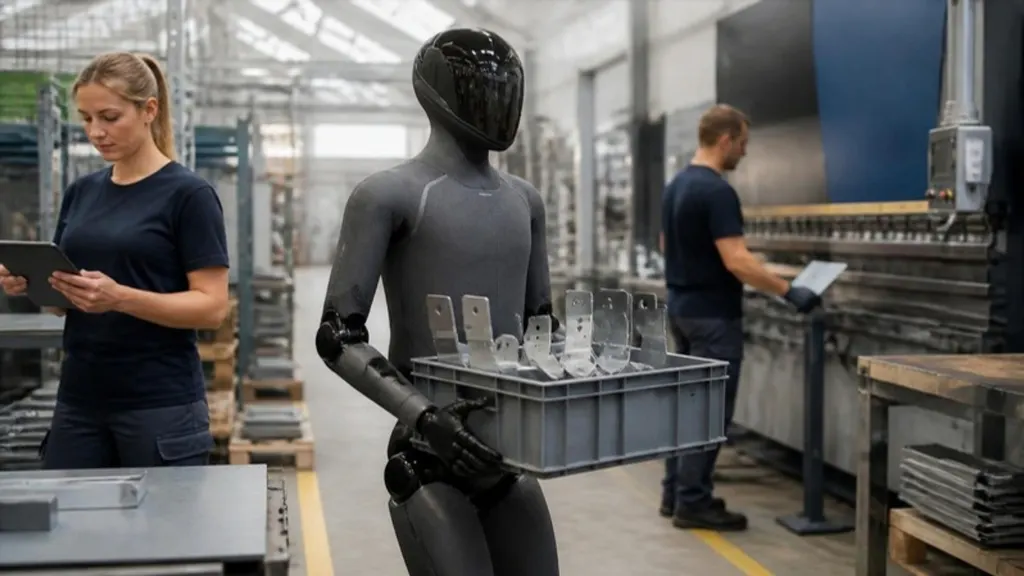 Illustrative image
Short answer
A humanoid robot is a general purpose robot with a torso, arms, hands and usually legs, steered by AI models that turn camera images and language into movement. The first factory tasks are handling jobs such as loading parts, sorting delivered components and moving packages. According to the IFR, a conventional industrial robot stays faster and more precise for one repetitive task.
What is a humanoid robot?
A humanoid robot is a mobile robot built roughly like a person, with a torso, two arms, hands and usually two legs. Because it has about the same reach as an operator, it can in principle use existing workstations, racks and carts. Its strength is switching between tasks in a space designed for people.
Most robots on a shop floor today look nothing like that. An industrial robot arm stands in a guarded cell and repeats one movement. A cobot is an industrial robot designed and safeguarded to share a workspace with people. AMRs and AGVs drive loads from one place to another. A humanoid robot combines walking, seeing and handling in one machine, which also makes it the least proven of these options.
| Industrial robot | Cobot | AMR or AGV | Humanoid robot | |
|---|---|---|---|---|
| What it is | Fixed arm in a guarded cell | Arm that shares a workspace with people | Vehicle that moves loads | Walking robot with arms and hands |
| Good at | Speed and repeatability on one task | Small series next to an operator | Transport between fixed points | Varied handling in spaces built for people |
| Less suited to | Frequent changes of task or product | Heavy loads at high speed | Picking and placing items | Matching the speed and precision of a fixed robot |
| Status | Widely used | Widely used | Widely used | Pilots and first deployments |
Why are humanoid robots arriving in factories now?
The main reason is physical AI, meaning AI models that turn camera images and spoken instructions into movement. A classic robot follows a program written for one task. A vision-language-action model, or VLA, learns from demonstrations and can handle objects it has never seen. At the same time, production of the robots is scaling up.
Figure's Helix model, presented in February 2025, shows how this works. According to Figure, an onboard vision-language model interprets the scene and the instruction at 7 to 9 Hz, while a fast policy turns that into continuous movement of wrists, fingers, torso and head at 200 Hz. Everything runs on the robot itself. Helix 02 followed in January 2026 and, says Figure, controls the whole body straight from camera pixels, walking and balance included.
On the production side, Figure says the first line of its BotQ factory can build up to 12,000 humanoids a year. In April 2026 it reported more than 350 Figure 03 robots delivered and an output of one robot per hour. BMW announced a Center of Competence for Physical AI in Production in February 2026.
The International Federation of Robotics (IFR) adds a sober note. Its 2025 position paper states that humanoids "will not compete with traditional industrial robots in terms of speed, precision, reliability and repeatability".
Sources
- Figure: Helix, a vision-language-action model (figure.ai)
- Figure: Helix 02 (figure.ai)
- Figure: BotQ manufacturing facility (figure.ai)
- Figure: Ramping Figure 03 production (figure.ai)
- BMW Group press release, February 2026 (press.bmwgroup.com)
- IFR position paper: Humanoid Robots, Vision and Reality (ifr.org)
What have humanoid robots done in a real plant so far?
The best documented case is BMW Group Plant Spartanburg. After a trial of several weeks in 2024, Figure 02 robots retrieved and positioned sheet-metal parts for welding on an active line for almost a year. In 2026 Figure 03 started a logistics task in the same plant, sorting delivered components for sequencing.
BMW reports that Figure 02 supported the production of more than 30,000 BMW X3 vehicles, five days a week in ten-hour shifts, moving over 90,000 components in some 1,250 operating hours. Figure adds that the cycle requirement was 84 seconds, with 37 seconds to load. These are figures from BMW and Figure about their own pilot.
BMW also names what it learned. The safety concept was revised with extra barriers and partitions, and 5G coverage in the hall was improved. In June 2026 Figure 03 arrived in Hall 52, an assembly and logistics hall. There it picks unsorted components from larger containers and sorts them, and according to Figure it also pulls a large metal cart down the line.
Figure has published package handling as well. Its robots move packages from one conveyor to another and turn each one so the label faces the scanner. In June 2025 Figure reported 4.05 seconds per package, with labels correctly oriented about 95% of the time.
Sources
- BMW Group: successful test of humanoid robots in Spartanburg (2024) (press.bmwgroup.com)
- BMW Group: Figure 03 project in Spartanburg (2026) (press.bmwgroup.com)
- Figure: F.02 contributed to the production of 30,000 cars at BMW (figure.ai)
- Figure: F.03 arrives at BMW (figure.ai)
- Figure: Scaling Helix in logistics (figure.ai)
Which tasks on the shop floor come first?
First in line are handling jobs at stations built for people: taking parts from a container and placing them in a fixture, sorting and sequencing components for the line, moving totes and carts, and handling packages. These tasks vary too much for a simple fixed cell, yet they are simple enough to learn from demonstrations.
A task with one product, a fixed position and high volume usually suits an industrial robot or a cobot better. A humanoid robot becomes interesting where the work changes during the day, or where rebuilding the station around a robot costs more than the robot saves.
- Production: loading parts into fixtures, kitting for assembly and supplying machines with parts.
- Intralogistics: sorting delivered components, sequencing them for the line and moving totes or carts between stations.
- Warehouse and dispatch: moving packages between conveyors and turning labels towards the scanner, with bags and envelopes as well as boxes.
What does a humanoid robot ask of your company?
A humanoid robot needs room to move, a safety concept, reliable wireless coverage and clear instructions from your systems about which part goes where. Your team needs to know how to work beside it and when to step in. The BMW pilot shows that each of these points takes preparation.
For safety, industrial robots and cobots fall under ISO 10218-1 and ISO 10218-2, both revised in 2025. These editions include the collaborative requirements that used to sit in ISO/TS 15066. For humanoids and other robots that keep their balance actively there is no final ISO safety standard yet (October 2026); ISO/CD 25785-1 is in development. Until it is published, a risk assessment for your own situation decides which barriers and zones you need.
A robot that sorts or sequences parts has to know which order, which part and which slot. That information lives in your ERP, MES or WMS. Without a link to those systems, someone keeps telling the robot every change by hand. Operators and maintenance staff also need to know who supervises the robot and what happens when it stops.
Availability is limited. As of October 2026, Figure publishes no price and no order page for Figure 03 on figure.ai. According to Figure, robots from BotQ go to internal research, data collection and the development of commercial use cases, among other things.
Sources
How does BeeManaged help with a robotics orientation?
We build AI agents that work inside the processes of manufacturing and engineering companies, connected to ERP, CRM and service systems. For robotics we start with an orientation session. Together we look at which tasks qualify, what they ask of the workplace, safety, systems and people, and how a robot fits into the same process as your agents.
Our part is the process and the data around a task: which order it comes from, which system knows the part number and the slot, and where an agent can prepare the work so that a robot or an operator carries it out. You come away with a list of candidate tasks and the questions to put to a robot supplier.
What can you read in this section?
Four pages go deeper into the topics on this page. One explains Figure 03 and its work at BMW, two cover production and logistics tasks with a pilot plan, and one compares a humanoid robot with a cobot, an industrial robot and an AMR.
- Figure 03: what the robot from Figure AI is, what the Helix model does, what it did at BMW and what Figure says about availability.
- Manufacturing: which production tasks suit a humanoid robot, when a fixed robot or cobot fits better, what ERP and MES need to arrange, and how to set up a pilot.
- Logistics: humanoid robots in the warehouse and intralogistics next to AMRs, AGVs and pick-and-place cells, and the link with your WMS or ERP.
- Humanoid robot or cobot: what each type is good at, the safety standards that apply, and a decision table.
Updated · As of October 2026 · Author Roy Rutten, AI architecture and development
Frequently asked questions
What is a humanoid robot?
A humanoid robot is a mobile robot shaped roughly like a person, with a torso, arms, hands and usually legs. It can work at stations and racks built for people and is steered by AI models that link images and language to movement.
What is physical AI?
Physical AI is AI that acts in the physical world through a robot. Models such as Figure's Helix take camera images and instructions as input and produce movements of hands, arms and body as output.
What does a humanoid robot cost?
Figure publishes no price for Figure 03 and no order page on figure.ai (as of October 2026). Prices that circulate in the media do not come from Figure itself, so we do not repeat them.
Will a humanoid robot replace our industrial robots or cobots?
For one fixed, repetitive task that is unlikely. The IFR states that humanoids will not compete with traditional industrial robots on speed, precision, reliability and repeatability. A humanoid robot is aimed at varied handling work in spaces built for people.
Is there a safety standard for humanoid robots?
There is no final ISO safety standard for humanoid robots as of October 2026. ISO/CD 25785-1, for industrial mobile robots that balance actively, is in development. Industrial robots and cobots fall under ISO 10218-1 and ISO 10218-2.
Which tasks suit a humanoid robot first?
Handling tasks at stations built for people come first, such as loading parts into fixtures, sorting and sequencing components, moving totes and carts, and handling packages. BMW and Figure have shown the first two in the Spartanburg plant.
Does BeeManaged supply robots?
We build AI agents connected to your systems and help with the orientation: which tasks qualify, what they ask of your workplace and systems, and how a robot fits next to your agents.
Related
Humanoid robots
Figure 03: what the Figure AI humanoid robot does at work
Humanoid robots
Humanoid robots in manufacturing: which tasks fit first
Humanoid robots
Humanoid robots in logistics: where they fit in your warehouse
Humanoid robots
Humanoid robot or cobot: which fits your shop floor?
Integrations
Integrations: connect your systems to an AI agent
Plan an orientation session on robotics
We look at your processes together and pick out the tasks a robot could take on. You hear what that asks of your workplace, safety and systems before you speak to a supplier.